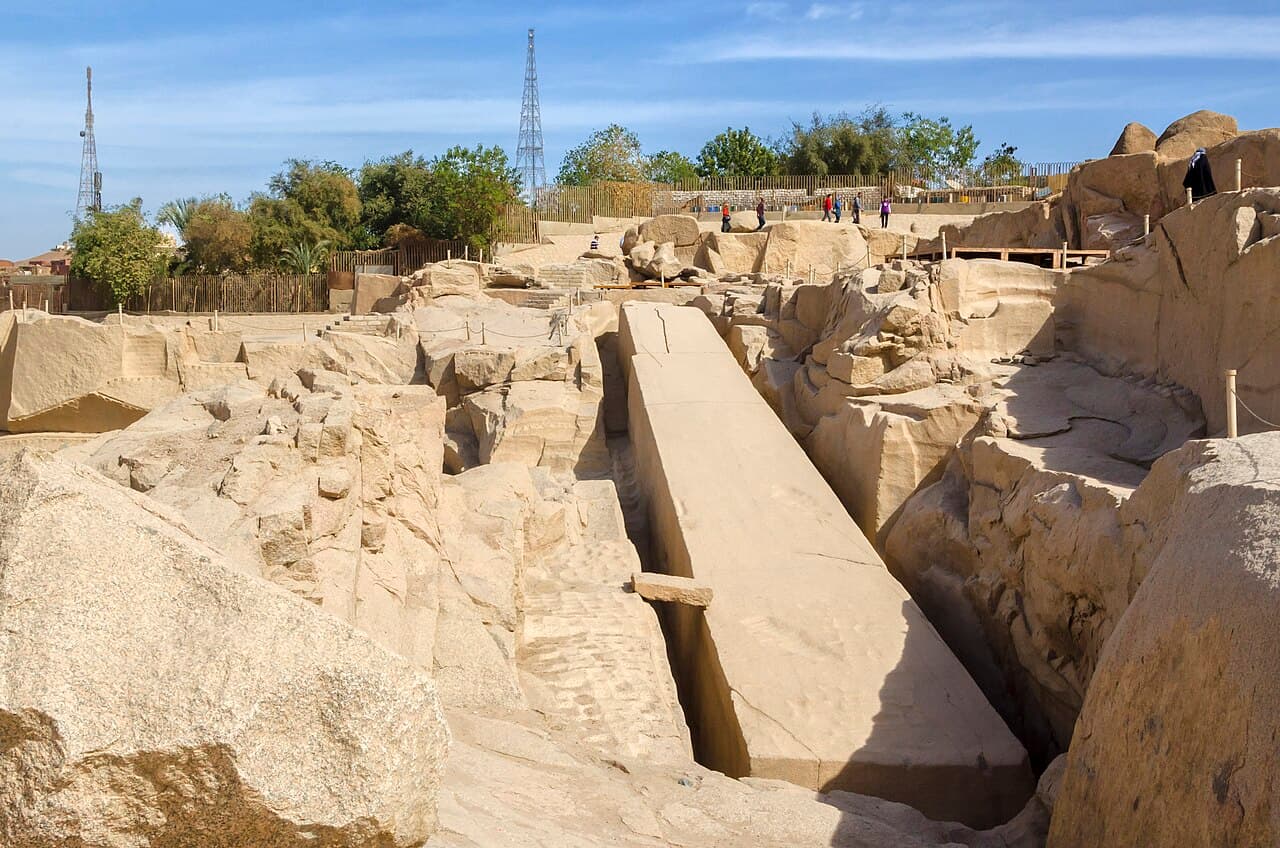
Unfinished obelisk of Aswan
The unfinished obelisk of Aswan would have been the largest ever cut (~42 m, ~1,100 t): abandoned mid-extraction because of cracks in the rock. Experimental archaeology has shown that dolerite pounders and quartz abrasives are enough to explain the cutting and polishing of the granite — without resorting to impossible tools. What remains an open question is not the 'how to cut' but the 'how to move': the details of the logistics of extracting, loading and erecting a monolith of this mass remain the real-scale mystery.
- Location
- Egypt · Near East
- Civilisation
- Ancient Egypt
- Period
- New Kingdom, reign of Hatshepsut (18th Dynasty, ~1490–1458 BC)
- Technique
- Percussion extraction with dolerite pounders (balls of 5–30 cm); use of fire to weaken the granite; finishing and polishing by abrasion with quartz sand and granite powder
- Studies
real support, not settled. A revisable snapshot of the state of research, never a judgement.
→ Show on the mapThe elements of the site
Where the site is
24.076° N, 32.895° E · satellite view
What science says
Dimensions and weight established by Engelbach (1923): 42 m long, weight estimated at ~1,168 t, roughly a third more than any known erected Egyptian obelisk. Engelbach carried out the first excavation and detailed measurement in 1921-1922, published in 'The Problem of the Obelisks' (T. F. Unwin, London, 1923). The obelisk remains partly attached to the bedrock.
Attribution to Hatshepsut and New Kingdom dating (~1490-1458 BC): consensus among Egyptologists, based on stratigraphic context and quarry style, but no dedicatory inscription has been found on the obelisk itself (Engelbach 1923, pp. 9-12). The link to Hatshepsut remains probable, not certain.
Cause of abandonment: natural cracks discovered in the granite mass during extraction. The three upper faces had been freed; the lower face remained anchored. The cracks compromised structural integrity (Engelbach 1923; Klemm & Klemm, Stones and Quarries in Ancient Egypt, British Museum Press, 2008).
Dolerite-pounder carving technique: experimentally demonstrated. Denys A. Stocks, engineer and experimental archaeologist, reproduced granite carving with dolerite pounders and copper tools — more than 250 reconstructed and tested tools (Stocks, 'Experiments in Egyptian Archaeology: Stoneworking Technology in Ancient Egypt', Routledge, 2003; expanded 2nd ed. 2023, ISBN 9780415306645). Conclusion: no 'impossible' tool is required.
Nature of the dolerite pounders established by Kelany, Harrell & Brown (2010): a study of 1,419 pounders from the quarry of the unfinished obelisk at Aswan. Average diameter: 14.2 ± 2.1 cm. The pounders were initially angular and irregular, not spherical — the spherical shape results from wear. They could not be held at the moment of impact (risk of injury): workers released them before impact and caught the rebound ('Dolerite Pounders: Petrology, Sources and Use', Lithic Technology, vol. 35, no. 2, 2010, pp. 127-148. DOI: 10.1080/01977261.2010.11721087).
Actual carving speed measured by photogrammetry in 2022, directly at the site of the unfinished obelisk: Marčiš & Fraštia conclude that the extraction rate is slower than estimated by previous work, reinforcing the scale of the labor investment required ('The problems of the obelisk revisited: Photogrammetric measurement of the speed of quarrying granite using dolerite pounders', Digital Applications in Archaeology and Cultural Heritage, vol. 30, 2023. DOI: 10.1016/j.daach.2023.e00284).
Surface polishing by abrasion: the flat surfaces and sharp angles of completed obelisks are obtained by progressive abrasion with quartz sand and granite powder. Stocks (2003) experimentally reproduced flat, polished finishes on granite using only these abrasives. Recent analyses also suggest the possible use of corundum (a mineral of hardness 9) in the Egyptian abrasive kit, though this is not yet settled (Penn Museum, 'Ancient Egyptian Stone-Drilling', Expedition Magazine; summarized in Stocks 2003, ch. 4-5). No laser or modern mechanical tool is required.
Transport by specialized barges on the Nile: the reliefs of Hatshepsut's mortuary temple at Deir el-Bahari depict a giant barge carrying two obelisks. A fragment of Egyptian text describes a ship ~63 m long and ~21 m wide built for this transport. The use of the Nile's annual flood and double-hulled barges is attested iconographically and textually (Engelbach 1923; article 'Obelisk ship', Wikipedia, Egyptological sources).
What remains unexplained
Parallels
Two giant vertical monoliths, carved from a single block in the quarry — a granite obelisk, a syenite stele carved to look like a multi-storey building. Two workshops, two continents, no known link.
Proposed — to be examinedRelated to
Studies & sources
Show 4 more sourcesCollapse sources
Keep exploring
 Debated
Stelae of Axum
Monolithic towers 33 meters tall, carved like 13-story buildings. In the 4th century, Axum was one of the four great world powers according to the prophet Mani. The largest was never successfully raised — and no text says how the others were.
 Consensus
Level-square of the Egyptian builders
A simple "A"-shaped frame weighted with a plumb line: the tool that made it possible to level the base of the Great Pyramid to within a few centimeters over more than 230 meters.
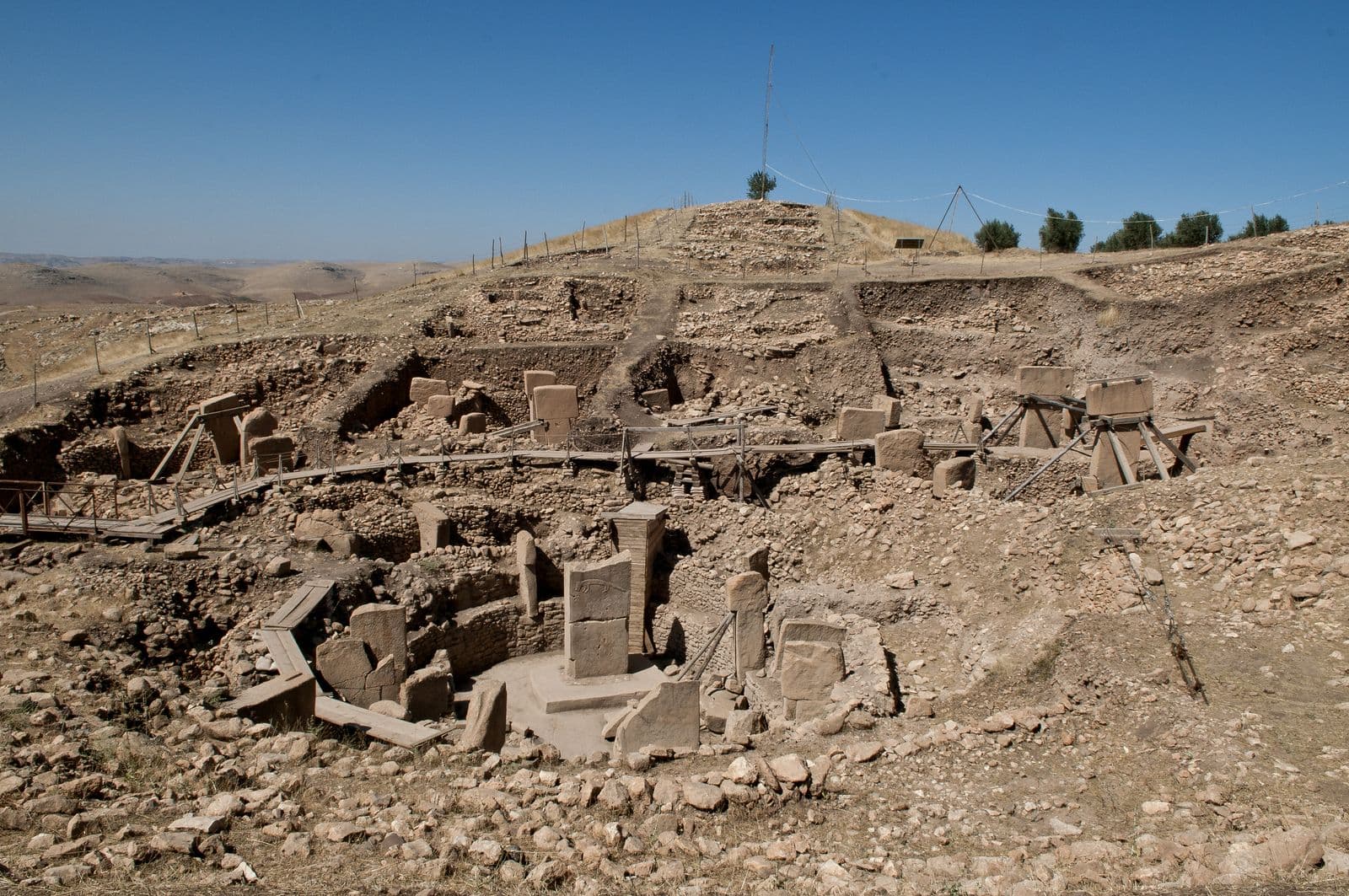 No accepted answer
Göbekli Tepe
A monumental complex built by hunter-gatherers, 6,000 years before the pyramids. Then buried — deliberately or by time, the debate is open.