
Stelae of Axum
Monolithic towers 33 meters tall, carved like 13-story buildings. In the 4th century, Axum was one of the four great world powers according to the prophet Mani. The largest was never successfully raised — and no text says how the others were.
- Location
- Ethiopia · Africa
- Civilisation
- Kingdom of Aksum
- Period
- 3rd–4th century AD
- Technique
- Monolithic nepheline syenite, false 13-story façades carved in trompe-l'œil
- Studies
real support, not settled. A revisable snapshot of the state of research, never a judgement.
→ Show on the mapThe elements of the site
Where the site is
14.131° N, 38.717° E · satellite view
What science says
The stelae are carved from nepheline syenite quarried at Gobedra and Wuchate Golo (~4 km to the west). Stele 1 (Great Stele): ~33 m, ~520 t — fallen and fragmented since antiquity. UNESCO describes it as 'possibly the largest monolith humans have ever attempted to erect'. Stele 2 (~24 m, ~152 t): taken by Mussolini in 1937, repatriated in three sections by Antonov 124 in April 2005, reassembled under UNESCO supervision (engineer Giorgio Croci) and inaugurated on 4 September 2008. Stele 3 (~20.6–21 m): the only great stele that never fell or was moved.
The stelae imitate facades of multi-storey Aksumite towers: false doors, false windows with lintels, projecting beam ends ('monkey heads'). This architectural vocabulary documents an Aksumite civil-construction tradition whose organic buildings did not survive. Inscribed as a UNESCO World Heritage site (site no. 15, 1980, criteria i and iv).
Dating: 3rd–4th century AD — broad consensus, but fine-grained per-stele dating is approximate. The great funerary stelae are probably pre-Christian (astral-solar decoration, no cross). Ezana's conversion (~330–340 AD) progressively ended this royal funerary tradition. The 'Ezana Stone' (trilingual Ge'ez/Sabaean/Greek inscription) documents the transition from polytheism to Christianity. Source: Phillipson (1997, 1998); Scielo (2021) on Christianization.
The prophet Mani (died 277 AD) cites Axum as one of the four great world kingdoms in his Kephalaia: "The first is the kingdom of Babylon and Persia, the second is that of the Romans, the third is that of the Aksumites, the fourth is that of Silis [China]." Axum is at that time the only civilization outside Rome and Persia to mint coins in gold, silver and bronze simultaneously. Source: Phillipson (1998); African History Extra.
What remains unexplained
Parallels
Two giant vertical monoliths, carved from a single block in the quarry — a granite obelisk, a syenite stele carved to look like a multi-storey building. Two workshops, two continents, no known link.
Proposed — to be examinedRelated to
Studies & sources
Show 1 more sourcesCollapse sources
Keep exploring
 Debated
Unfinished obelisk of Aswan
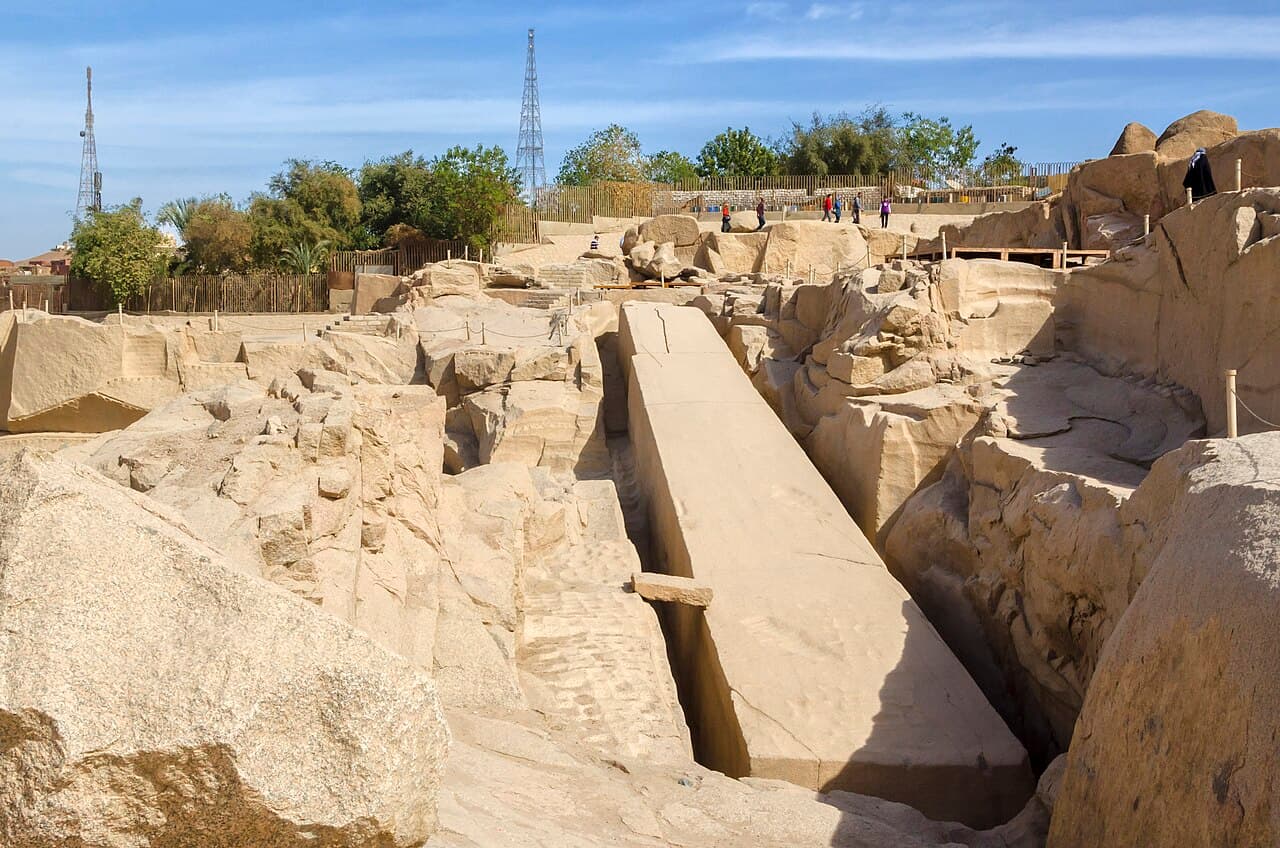
The unfinished obelisk of Aswan would have been the largest ever cut (~42 m, ~1,100 t): abandoned mid-extraction because of cracks in the rock. Experimental archaeology has shown that dolerite pounders and quartz abrasives are enough to explain the cutting and polishing of the granite — without resorting to impossible tools. What remains an open question is not the 'how to cut' but the 'how to move': the details of the logistics of extracting, loading and erecting a monolith of this mass remain the real-scale mystery.
 Debated
Thimlich Ohinga
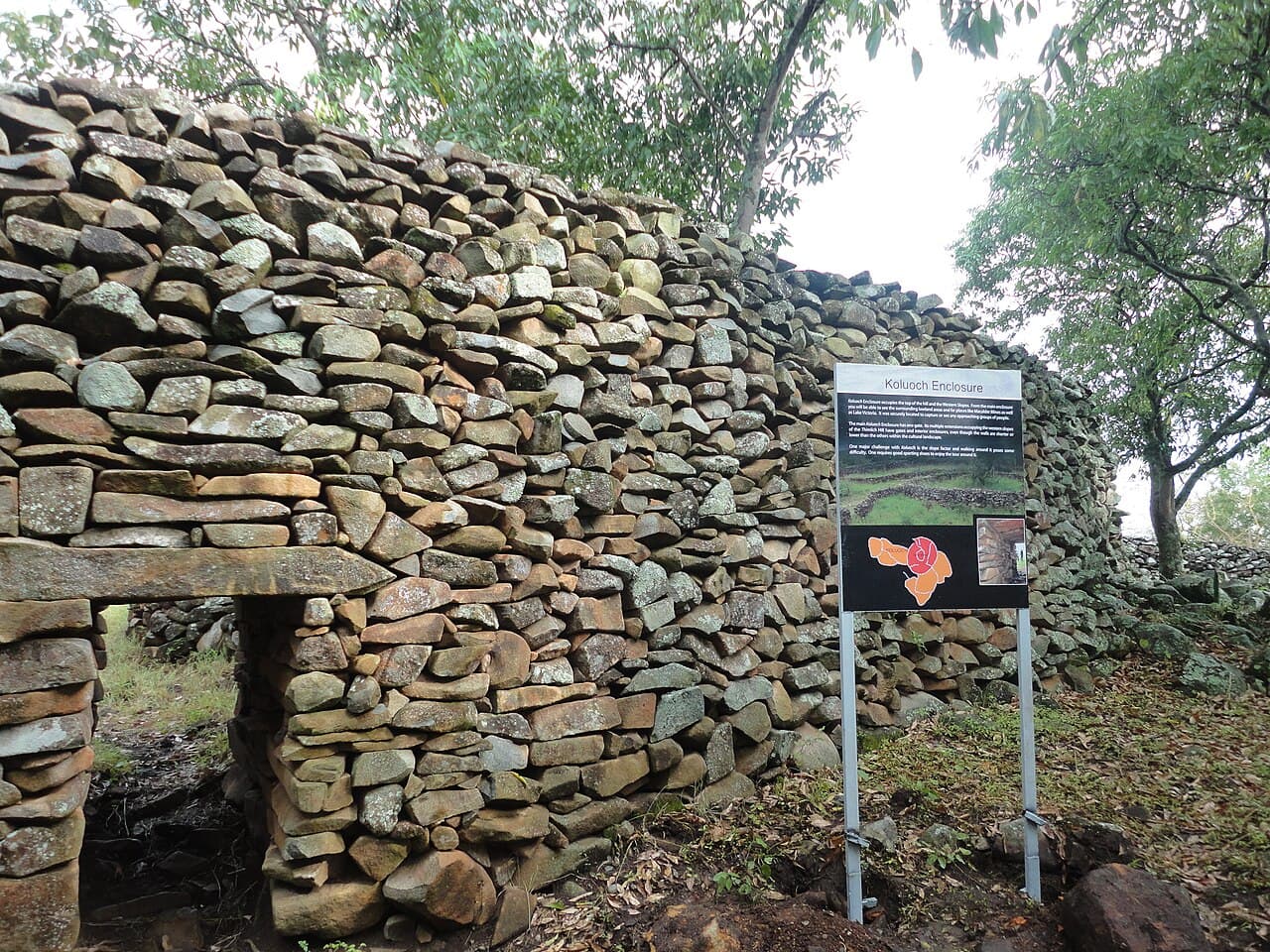
Double-faced dry-stone enclosures, without mortar, near Lake Victoria. Built between the 15th and 16th centuries by Bantu communities and later the Luo. Who started them, who continued them?
 Debated
Osireion of Abydos
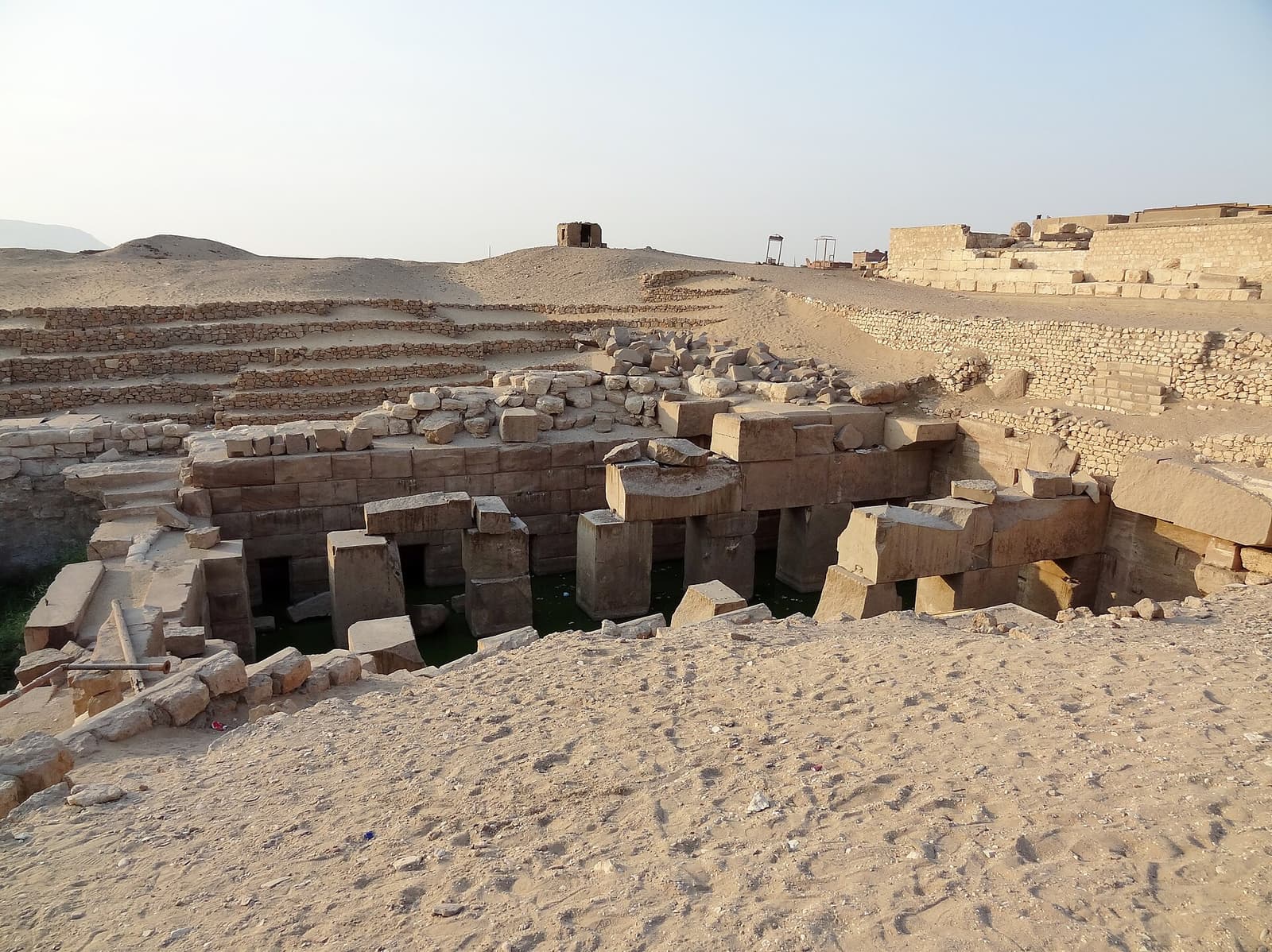
A massive granite structure buried 13 meters under the sand, flooded by the water table for centuries. Built by Seti I as a cenotaph of Osiris — the theory of an older site, advanced by Naville in 1914, has since been refuted but is still sometimes cited.