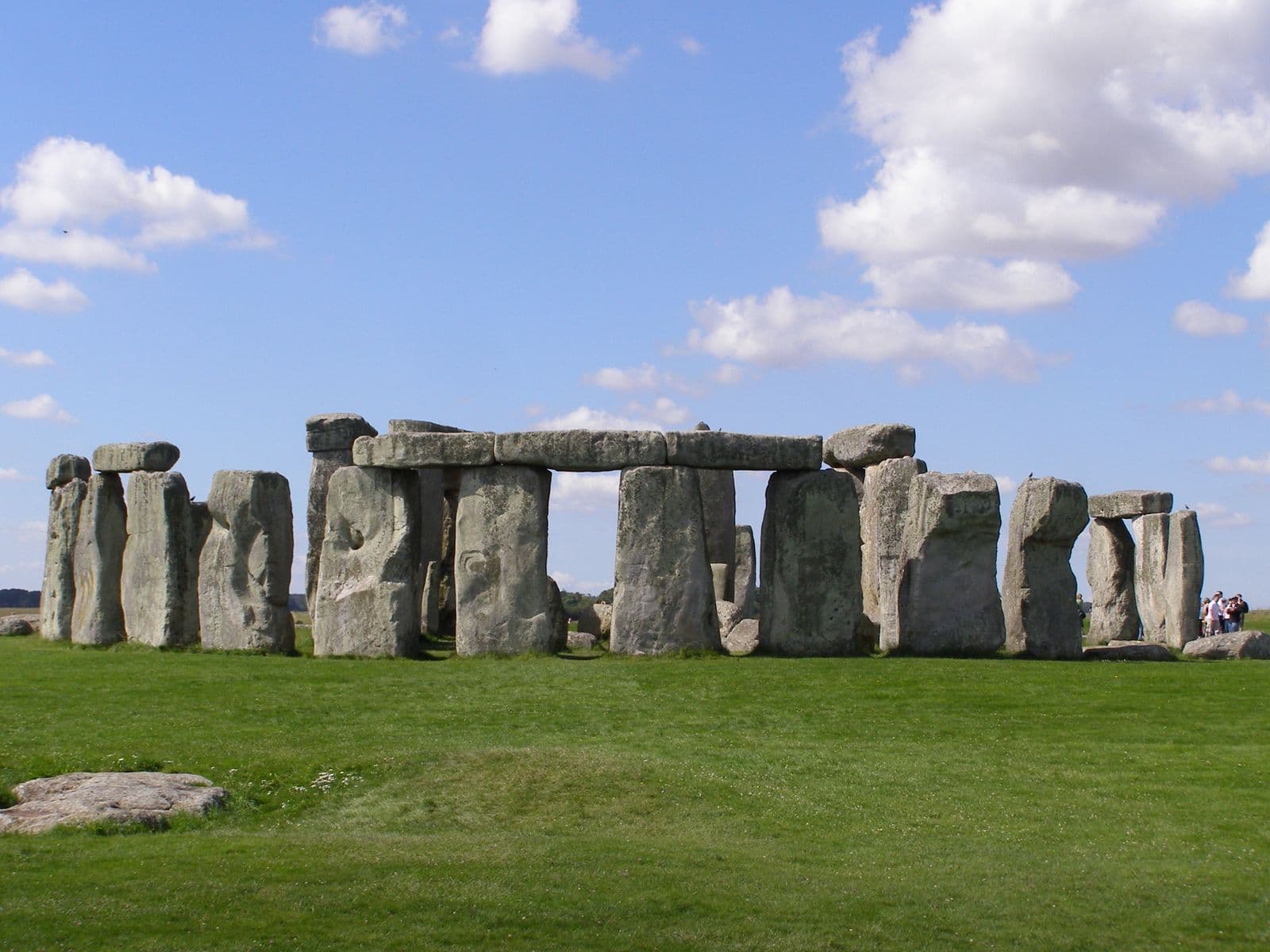
Stonehenge
The bluestones traveled 250 km from Wales. And the altar stone, from Scotland. Why those particular stones?
- Location
- England · Europe
- Civilisation
- British Neolithic
- Period
- −3000 → −2000
- Technique
- 25 t sarsens, mortise and tenon joints
- Studies
- 1,000+ publications
real support, not settled. A revisable snapshot of the state of research, never a judgement.
→ Show on the mapThe elements of the site
Where the site is
51.180° N, 1.830° W · satellite view
What science says
The Welsh origin of the bluestones (Preseli hills) is confirmed by geochemistry.
The solstitial axis is measured, not assumed: sunrise at the summer solstice, sunset at the winter solstice.
Burials, cremations and deposits form a consensus on a ceremonial and funerary function.
The 50 main sarsens (~25 t, up to 7 m tall) come from West Woods, Wiltshire, only ~25 km to the north: a local source identified by PXRF geochemistry (Nash et al., Science Advances 2020). Two outlier sarsens have a different, not yet identified, provenance.
The 5-phase construction sequence (Darvill, Marshall, Parker Pearson & Wainwright, Antiquity 2012) spans roughly 3000 to 1500 BC: Phase 1 = earth henge and Aubrey Holes (~3000 BCE); Phase 2 = first bluestones (~2600 BCE); Phase 3 = great sarsen architecture (~2500 BCE); Phases 4-5 = rearrangements of the bluestones (~2200-1500 BCE).
63 cremated individuals have been identified in the Aubrey Holes, buried over ~500 years (~3000-2500 BC). At least 10 of 25 analyzed individuals were of non-local origin; 4 among the earliest buried are geochemically compatible with an origin in western Wales (Snoeck et al., Scientific Reports 2018).
What remains unexplained
Related to
Studies & sources
Show 21 more sourcesCollapse sources
Keep exploring
 Consensus
Avebury Circle
With its 11.5 hectares (28.5 acres) enclosed by a ditch 9 m deep and an outer circle 338 m in diameter, Avebury is Europe's largest megalithic henge monument. Built in phases between ~2850 and ~2200 BC, it holds around a hundred sarsens, exact count still debated, — many toppled or buried in the Middle Ages — two inner circles and a 2.4 km avenue.
 Debated
Silbury Hill
Europe's tallest prehistoric man-made mound — a hill of stacked chalk with no known burial — built around 2400 BC by the societies of Stonehenge. How? Mastered. Why? Still unanswered.
 Debated
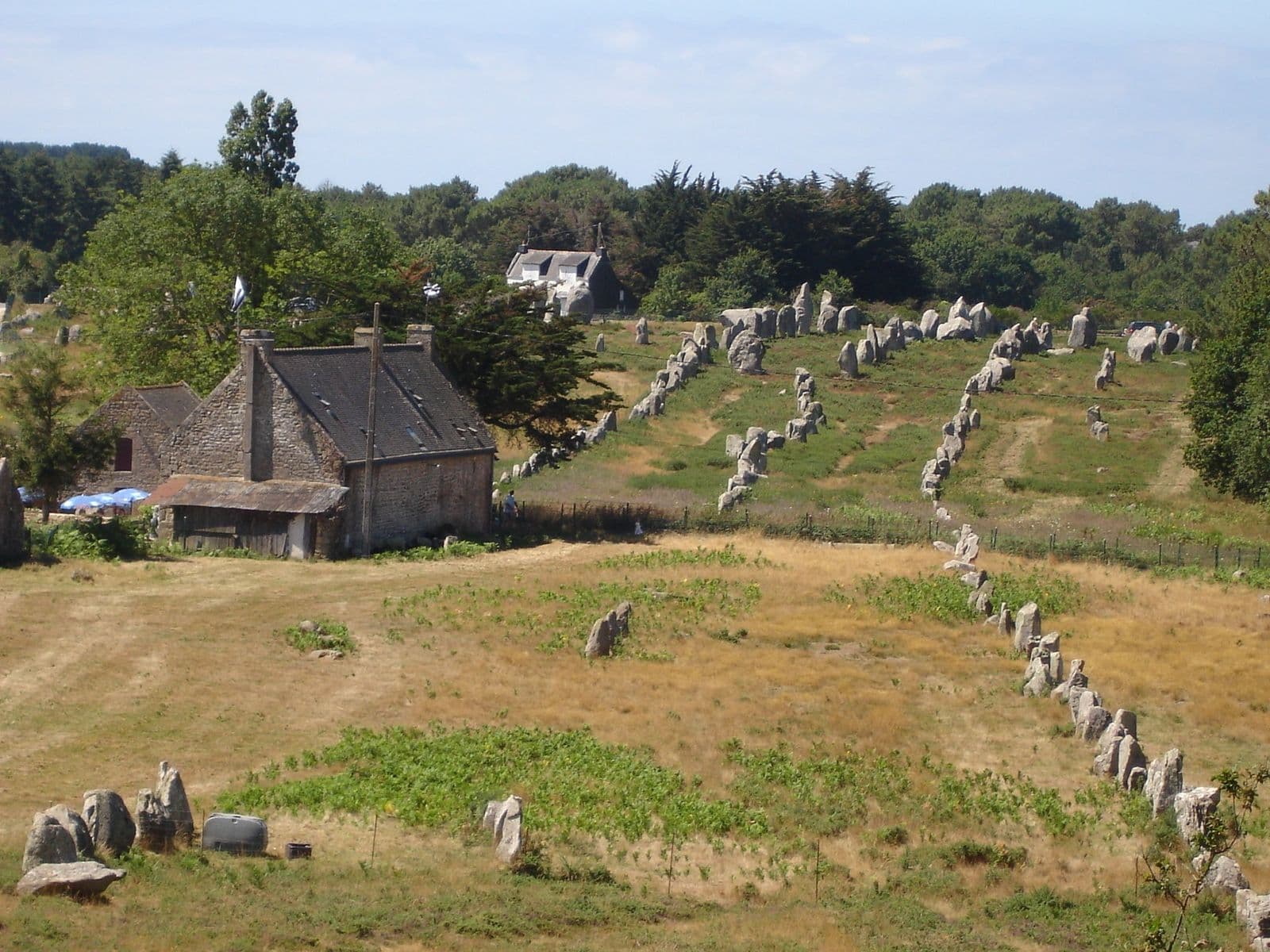
Carnac Stones
More than 3,000 standing stones in rows over ten kilometers. The largest megalithic complex in the world, dated between 4600 and 4300 BC — with no text to explain it.