
Valley Temple of Khafre
The best-preserved funerary temple of the Old Kingdom. Not a single hieroglyph on its walls. Carved from the same rock as the Sphinx enclosure, it shares its origin — and its controversy.
- Location
- Egypt · Africa
- Civilisation
- 4th Dynasty (Khafre)
- Period
- ~−2520 → ~−2494 BC
- Technique
- Limestone blocks 100–200 t, Aswan granite cladding, 16 monolithic pillars
- Studies
real support, not settled. A revisable snapshot of the state of research, never a judgement.
→ Show on the mapThe elements of the site
Where the site is
29.975° N, 31.128° E · satellite view
What science says
The temple is attributed to Khafre (Khephren), 4th Dynasty, reign ~2520–2494 BC. The dating rests on three independent pillars: architectural stratigraphy (the north foundation of the Sphinx Temple partially overlies the north wall of the Valley Temple, proving the latter's priority), geological correspondence of the blocks (quarried from the Sphinx's U-shaped ditch, same stratification — Lehner & Aigner 1980), and the statuary corpus: the 23 statues of Khafre found in situ (Mariette excavations 1860, Reisner) attest to the royal attribution unambiguously.
Architecture: square plan (~44 m per side), limestone core, red Aswan granite cladding, alabaster floor. T-shaped hall with 16 monolithic granite pillars. No reliefs, no inscriptions — an austerity with no consensus explanation: partial incompleteness or a pragmatic function (purification of the royal body before embalming) are the two readings on the table.
Most accepted function: a temple for purification and preliminary mummification. The body arrived by waterway (canal), and underwent the rites of the ibu (purification tent) and the wabet (pure place), including the opening-of-the-mouth ceremony. A rising causeway of ~494 m connected the temple to the upper funerary complex. Source: Hawass (1987), Lehner & Hawass (2017).
What remains unexplained
Related to
Studies & sources
Show 1 more sourcesCollapse sources
Keep exploring
 Debated
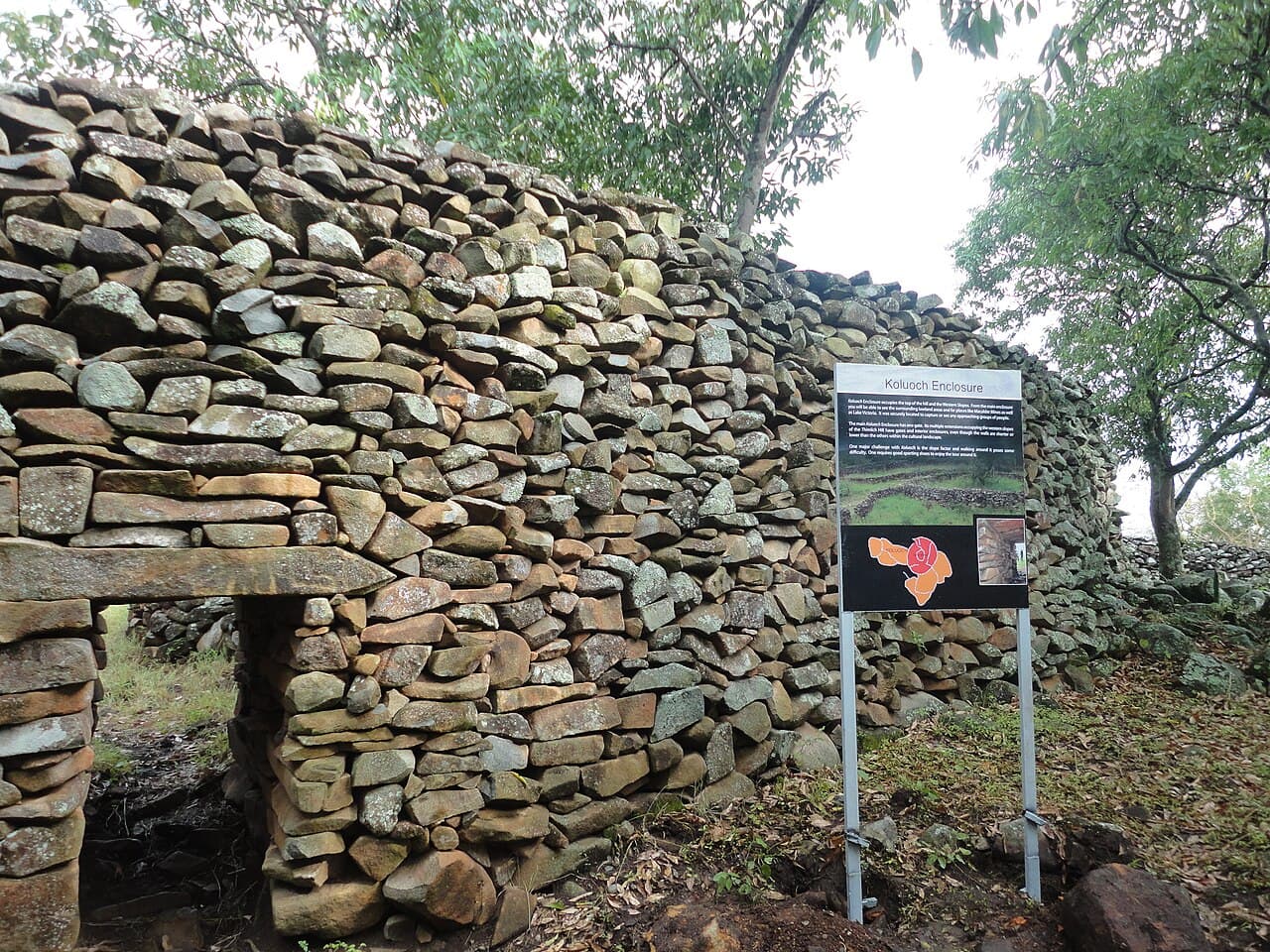
Thimlich Ohinga
Double-faced dry-stone enclosures, without mortar, near Lake Victoria. Built between the 15th and 16th centuries by Bantu communities and later the Luo. Who started them, who continued them?
 Debated
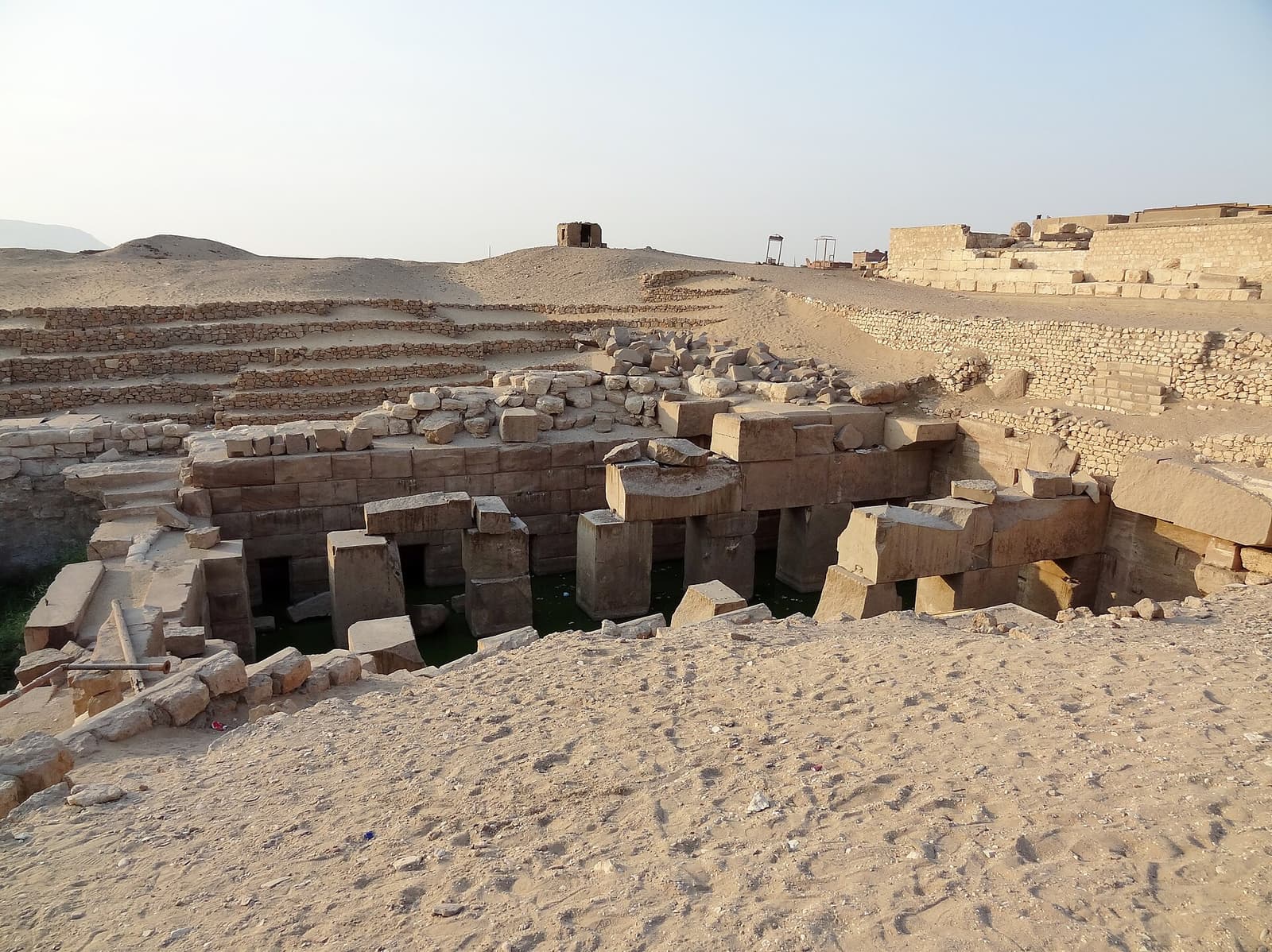
Osireion of Abydos
A massive granite structure buried 13 meters under the sand, flooded by the water table for centuries. Built by Seti I as a cenotaph of Osiris — the theory of an older site, advanced by Naville in 1914, has since been refuted but is still sometimes cited.
 Consensus
Churches of Lalibela — Biete Ghiorgis
Eleven churches carved from a single block of rock, with no masonry added. At Lalibela, construction does not add up — it subtracts. Biete Ghiorgis, the most perfect, descends into a trench 25 m to a side: a three-dimensional Greek cross cut into the tuff, with its gutters, its light shafts and its drainage channels, still in use 800 years later.