Megaliticsbeta

Recherche

Chercher un site, un artefact ou un dossier de l’atlas

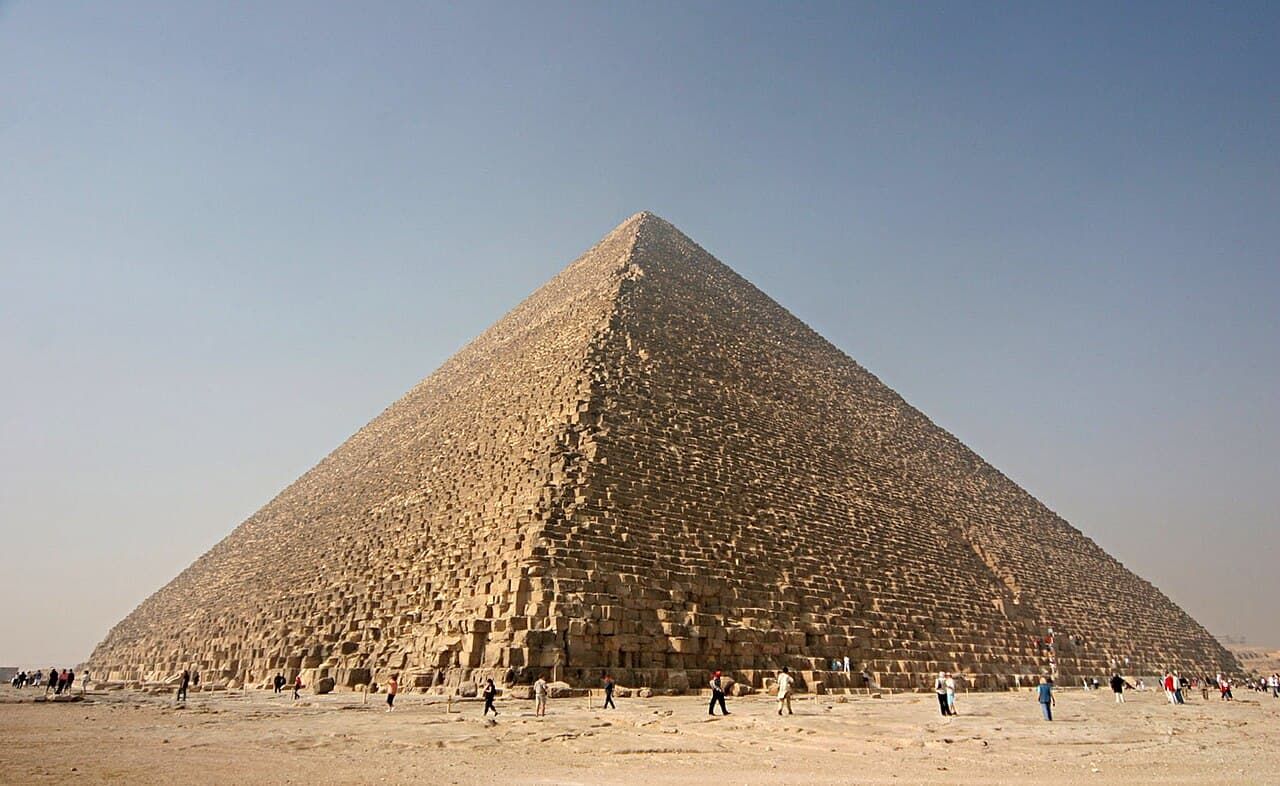
Great Pyramid of Giza
DebatedSite

Great Pyramid of Giza

The best-documented construction site of the ancient world — a 4,500-year-old inspector's logbook, an excavated workers' town, and muon physics still uncovering unknown voids.

Location
Egypt · Near East
Civilisation
Egypt, 4th Dynasty (Khufu)
Period
~−2560
Technique
2.3 million blocks, ~6 Mt, ~20 years
Studies
thousands of publications

real support, not settled. A revisable snapshot of the state of research, never a judgement.

→ Show on the map
In pictures

The elements of the site

8 photos · Wikimedia Commons
© Gary Todd from Xinzheng, China · CC0
Location

Where the site is

29.980° N, 31.130° E · satellite view

🔬 Science

What science says

  • The Diary of Merer (Wadi al-Jarf, ~2560 BC): the logbook of an inspector ('sḥḏ') delivering limestone blocks from Tura to Akhet-Khufu (the Giza complex), dated to about year 27 of Khufu's reign — the oldest direct written evidence of the construction project.

  • The workers' town (Lehner/AERA): bakeries, dormitories, rations — a state-fed construction project, not slaves.

  • Crew graffiti in the relieving chambers and C14 dates consistent with the 4th Dynasty.

  • ScanPyramids (muography, 2017-2023): a 'big void' of minimum length 30 m above the Grand Gallery (Nature 2017, DOI 10.1038/nature24647) and a north corridor of ~9 m behind the north face (Nature Communications 2023, DOI 10.1038/s41467-023-36351-0) — two unknown structures revealed by particle physics.

  • The alignment to true north within ~3 arcminutes is documented by geodetic survey. The method used by the builders remains debated: simultaneous transit of the stars Kochab-Mizar (Spence, Nature 2000, DOI 10.1038/35042510) or the Phecda-Megrez pair (Belmonte, 2001, DOI 10.1177/002182860103202601). Both hypotheses invoke celestial precession to explain the residual discrepancy.

🜂 Mystery

What remains unexplained

ancient ⇄ current science

Echoes across time

Great Pyramid⇄Muography — particle physics examines monumentsDocumented

Cosmic muons revealed two unknown voids in Khufu's pyramid. Fundamental physics becomes an archaeology tool.

ScanPyramids · Nature (2017) · Nature Comm. (2023)

themes & techniques

Related to

EgyptExtreme liftingScanPyramidsArchaeoastronomy
with the lens shown

Videos

BothThe Void — what do the ScanPyramids data really show?History for Granite (EN)
BothThe Dibble ⇄ Hancock debate (2024): what counts as evidence?débat public
every line can be checked

Studies & sources

ConsensusTallet P. & Marouard G., « The Harbor of Khufu on the Red Sea Coast at Wadi al-Jarf, Egypt », Near Eastern Archaeology 77/1 (2014), pp. 4–14↗ConsensusTallet P., Les papyrus de la mer Rouge I — Le « Journal de Merer » (Papyrus Jarf A et B), MIFAO 136, IFAO, Le Caire, 2017↗ConsensusTallet P., Marouard G. & Laisney D., « Un port de la IVe dynastie au ouadi el-Jarf (mer Rouge) », BIFAO 112 (2012), pp. 399–446↗Peer-reviewBonani G., Haas H., Hawass Z., Lehner M. et al., « Radiocarbon Dates of Old and Middle Kingdom Monuments in Egypt », Radiocarbon 43/3 (2001), pp. 1297–1320↗Peer-reviewHaas H., Devine J., Wenke R., Lehner M., Wolfli W. & Bonani G., « Radiocarbon Chronology and the Historical Calendar in Egypt », BAR International Series 379 (II), 1987, pp. 585–606↗
Show 17 more sources
ConsensusPetrie W.M.F., The Pyramids and Temples of Gizeh, Field & Tuer, Londres, 1883↗Peer-reviewMorishima K. et al., « Discovery of a big void in Khufu's Pyramid by observation of cosmic-ray muons », Nature 552 (2017), pp. 386–390↗Peer-reviewProcureur S. et al., « Precise characterization of a corridor-shaped structure in Khufu's Pyramid by observation of cosmic-ray muons », Nature Communications 14 (2023) 1144↗Peer-reviewSpence K., « Ancient Egyptian chronology and the astronomical orientation of pyramids », Nature 408 (2000), pp. 320–324↗Peer-reviewBelmonte J.A., « On the Orientation of Old Kingdom Egyptian Pyramids », Archaeoastronomy (suppl. Journal for the History of Astronomy) 26 (2001)↗ConsensusLehner M. & Hawass Z., Giza and the Pyramids: The Definitive History, University of Chicago Press, 2017 (ISBN 9780226425696)↗ConsensusLehner M., The Complete Pyramids: Solving the Ancient Mysteries, Thames & Hudson, Londres, 1997 (ISBN 9780500050842)↗ConsensusAERA (Ancient Egypt Research Associates), The Lost City of the Pyramid Builders — documentation officielle fouilles Heit el-Ghurab↗ConsensusAERA, How Old Are the Pyramids? — synthèse officielle programmes datation C14 (1984 et 1995)↗ConsensusHawass Z., The Secrets of the Sphinx: Restoration Past and Present, American University in Cairo Press, 1998 (ISBN 9789774244926)↗ConsensusGantenbrink R., Upuaut Project — exploration robotique des puits de la pyramide (1992–1993) ; découverte de la dalle bloquante (puits sud chambre de la Reine, 22 mars 1993)↗ConsensusArnold D., Building in Egypt: Pharaonic Stone Masonry, Oxford University Press, New York, 1991 (ISBN 9780195063509)↗AlternativeGoyon G., Le Secret des bâtisseurs des grandes pyramides : Khéops, Pygmalion, Paris, 1977↗Peer-reviewGoyon G., « Les Rangs d'assises de la grande pyramide », BIFAO 78 (1978)↗AlternativeHoudin J.-P., Khufu: The Secrets Behind the Building of the Great Pyramid, Fayard, 2006 (trad. anglaise ; préf. Hawass) — hypothèse rampe interne spirale, non peer-reviewed↗ConsensusIsler M., Sticks, Stones, and Shadows: Building the Egyptian Pyramids, University of Oklahoma Press, 2001↗Peer-reviewRosell Roig V.L., « A computational framework for evaluating an edge-integrated, multi-ramp construction model of the Great Pyramid of Giza », npj Heritage Science 14, art. 142 (2026)↗
Discover

Keep exploring